


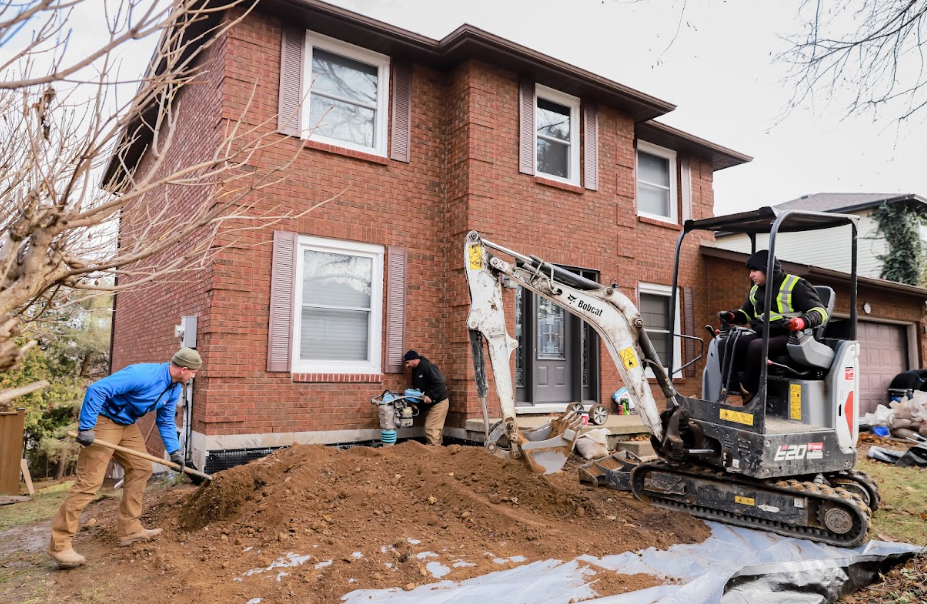

The snow has fallen, the ground has frozen solid, and a damp corner in the basement has been bothering you for weeks. Most people decide to wait for spring. It seems sensible: why dig, drill or pour concrete in the cold? In fact, winter is one of the best times to deal with a wet basement, and waiting can cost you the best slot.
In spring the snow melts, the ground has barely thawed, and the rain arrives on top of it. That is the moment many basements start to leak, and it is also the moment every waterproofing crew gets busy. If you fix the problem before then, you spend the thaw watching the forecast instead of the floor drain.
This guide explains what winter does to a basement, how to tell whether yours has a problem, which jobs we happily do in the cold, which ones take more care, and why booking before the thaw makes sense.
The short answer: work inside the house doesn’t care about the weather. We can still do work outside in winter, and we do it year-round. What winter gives you is time to fix the problem before the spring thaw and the heavy rain arrive.
What winter does to a basement
Freeze and thaw widen cracks
First, water gets into a small crack. Then it freezes and expands, which opens the crack a little more. When it thaws, even more water follows it in. After a few dozen cycles over a winter, a hairline crack can become a leak. If you want to know what you are looking at, see our guide to telling structural cracks from cosmetic ones.
Frozen ground can’t drain
When the soil is frozen, it can’t soak up water the way it does in summer. Instead, meltwater and rain run along the surface, and if the ground slopes toward the house, they run straight to the foundation. For that reason, a midwinter thaw can send more water at your basement than a summer storm.
Damp and mould are easier to spot
In a closed-up house, a cold wall meets warm indoor air, and that means condensation. As a result, stains, a musty smell and a damp patch at the base of the wall all show up more clearly in winter. Here is why moisture and mould go together.
Window wells fill with snow
Snow and ice pile up in a window well. When they melt, the water has nowhere to go but the window, so a cover and a well that drains properly make a real difference.
Signs your basement has a winter problem
- White, chalky powder on the walls or floor.
- Damp patches or a dark line at the base of a wall, especially after a thaw.
- Frost or ice on the inside of a basement wall.
- A musty smell that comes back after you air the room out.
- Stains or drips under a basement window.
- A sump pump that runs far more often when the snow melts.
If you notice any of these, photograph them, with a coin or a ruler beside them for scale, and mark the date. It helps the technician a great deal.
Winter or wait?
Not every job is the same in the cold. Interior jobs happen inside a heated house. Exterior jobs mean digging, which is slower when the ground is frozen. And a few jobs are really better left for spring. Here is how the common ones compare.
Why winter is a good time to book
Interior work is weather-proof. Interior waterproofing, a sump pump, a battery backup and a backwater valve all happen indoors, so the outside temperature doesn’t matter.
Exterior work is still possible. We do exterior waterproofing through the winter, and only pause in extreme cold, around -20°C. Digging in frozen ground is slower, so ask us about timing for your job.
You beat the rush. Jobs are usually booked about 4 to 6 weeks after you accept a quote, and after heavy rain, when many basements leak at once, the wait for a visit can stretch to one or two weeks. Book in winter, and the work can be finished before the thaw.
The usual order of things. Timing varies with the season and the size of the job.
A technician usually comes within a day or two. After heavy rain, the wait can be one to two weeks.
Itemized and free. Nothing is scheduled until you accept it.
Jobs are usually booked about 4 to 6 weeks after you accept, depending on the size and the season.
Interior work usually takes 1 to 3 days, and exterior work 3 to 5 days.
Why it matters in winter: book now, and the work can be done before the spring thaw and the heavy rain. Book a free assessment.
The leak shows itself. A basement that leaks at the thaw is easier to diagnose when you have seen it happen. Photograph any damp or staining now, and show it to the technician.
You stop the damage early. Every thaw makes a wet basement a little worse, and a little more expensive. A problem fixed in January costs less than the same problem in June, after it has had a spring to grow.
What the work looks like in winter
Inside. With interior waterproofing, we install a drainage system along the base of the foundation walls. It carries the water that reaches the wall to a sump pump. We do the work in the basement, so frost outside makes no difference. It usually takes 1 to 3 days.
Outside. With exterior waterproofing, the crew digs down to the footing, seals the wall with a waterproof membrane, and installs new weeping tile to carry groundwater away. It usually takes 3 to 5 days. Frozen ground slows the digging, and extreme cold will pause the job, but most winter weather doesn’t stop us.
What it costs
The season doesn’t change how we price the job. Interior waterproofing typically costs $69 to $190 per linear foot, and exterior waterproofing $110 to $500. A sump pump typically costs $550 to $3,650, and crack repair $400 to $800 per crack. The final number depends on the length of wall, how deep it is and how easy it is to reach. Only a free on-site estimate gives you a figure for your house. See our basement waterproofing cost guide.
What to do in the meantime
- Photograph any damp, stains or cracks, with a coin or ruler beside them for scale.
- Keep snow shovelled away from the foundation, and keep window wells clear.
- Test the sump pump with a bucket of water, and keep your hands out of the pit.
- Move stored boxes off the floor and away from the walls.
- Run a dehumidifier if the basement feels damp. See our winter suggestions to protect from water damage.
Questions to ask when you book
- Is the job inside or outside, and does the cold affect it?
- If the ground is frozen, how does that change the timing?
- What is in the written quote, and are any extras listed separately?
- What warranty comes with the work, and does it transfer if I sell?
- When can you start, and how long will it take?
Our guide to what a waterproofing quote should include shows how to compare quotes.
How Aquatech helps
We start with a free on-site inspection, find where the water is coming from, and tell you honestly what the basement needs and when we can do the work. Then you get a written, itemized estimate. A lifetime warranty backs every project and transfers to the next owner. Also, if you have a comparable written quote from a licensed Ontario contractor, we will match it. If water is coming in right now, we answer 24/7, so see our emergency waterproofing.
FAQs about waterproofing in winter
Can basement waterproofing be done in winter?
Can basement waterproofing be done in winter?
Is exterior waterproofing possible in frozen ground?
Is exterior waterproofing possible in frozen ground?
Will the cold affect crack repair?
Will the cold affect crack repair?
Why do cracks seem to get worse in winter?
Why do cracks seem to get worse in winter?
How long does it take to get the work done?
How long does it take to get the work done?
Should I wait for spring?
Should I wait for spring?
Does winter work cost more?
Does winter work cost more?
What if water comes in during a thaw?
What if water comes in during a thaw?
Is your basement ready for the thaw?
Book a free assessment. We will look at the basement, tell you what it needs and when, and give you a written, itemized estimate.
