



A leak spoils a good basement, and water finds many ways in. One of them is through the mortar joints. This usually happens when the foundation is built of concrete block, brick or stone, and not of poured concrete. Water follows the path of least resistance through the mortar, and it eventually shows up inside the basement.
This guide explains the signs, why mortar fails, and the four fixes, so you can tell which one fits your wall.
The short answer: repointing fixes worn mortar above ground, and waterproofing deals with water pressure below ground. Which one you need depends on where the leak is, and where the water comes from. See our basement leak repair service.
Signs of a leaking mortar joint
- Wet-looking blocks or bricks, especially around the mortar lines.
- Bricks that wear out faster than the rest. The mortar around them may be deteriorating, which marks a point of entry.
- Water stains on the inside wall. A closer look may show that the water came through the mortar.
- Puddles under wet blocks. They point to a bad leak that is almost certainly linked to a joint.
- Crumbling, sandy or missing mortar, or joints that you can scratch out with a key.
- White powder on the wall. It is efflorescence, and it shows that water is moving through. See efflorescence sources and removal.
A block wall can be harder to read, because the blocks are hollow. Water can enter at the mortar, travel through the hollow cores, and show up inside the house a long way from the real entry point.
How water travels through a block wall
The picture below shows how water enters at a worn joint, follows the mortar in a stair-step path and appears away from the entry point.
How water travels through a block wall
- The entry point. Worn, thin or cracked mortar lets water into the wall from the soil side.
- The path. Water follows the joints, and travels through the hollow cores of the blocks.
- Where it shows. It can appear inside, well away from where it went in.
- The base of the wall. Water collects at the bottom, and wets the floor edge.
- A stair-step crack. Cracks that follow the joints in a stair-step pattern point to movement as well as water.
A simplified view of a block wall, not to scale.
Why mortar joints leak
- Age and weather. Mortar wears out over time, especially after years of freeze and thaw.
- Poor construction. Weak or thin mortar, or poor-quality materials, breaks down faster.
- Water pressure. When the soil beside a below-ground wall is saturated, the water pushes through the joints. See understanding hydrostatic pressure.
- Movement. A wall that shifts cracks the mortar, and stair-step cracks along the joints often point to it. See how to tell structural cracks from cosmetic ones.
- Drainage and grading. Water that collects beside the wall loads every joint. See improving your home’s drainage.
Water always finds a path. That is why the lasting fix deals with the water as well as the mortar.
Four fixes for a leaking mortar joint
The cards below compare the four options, with what each one is best for and where it falls short.
Four fixes for a leaking mortar joint
Which one fits depends on where the wall is, and where the water comes from.
A general guide. A free on-site assessment shows which one your wall needs.
Repointing, for worn mortar above ground
Repointing, also called tuckpointing, means raking out the damaged mortar and filling the joints with new mortar. It suits wall sections above ground, where the weather has worn the mortar. It fixes the entry point, but it doesn’t relieve water pressure below ground, so it is priced and done by a mason, and we can advise where it fits.
Exterior waterproofing, to stop the water at the wall
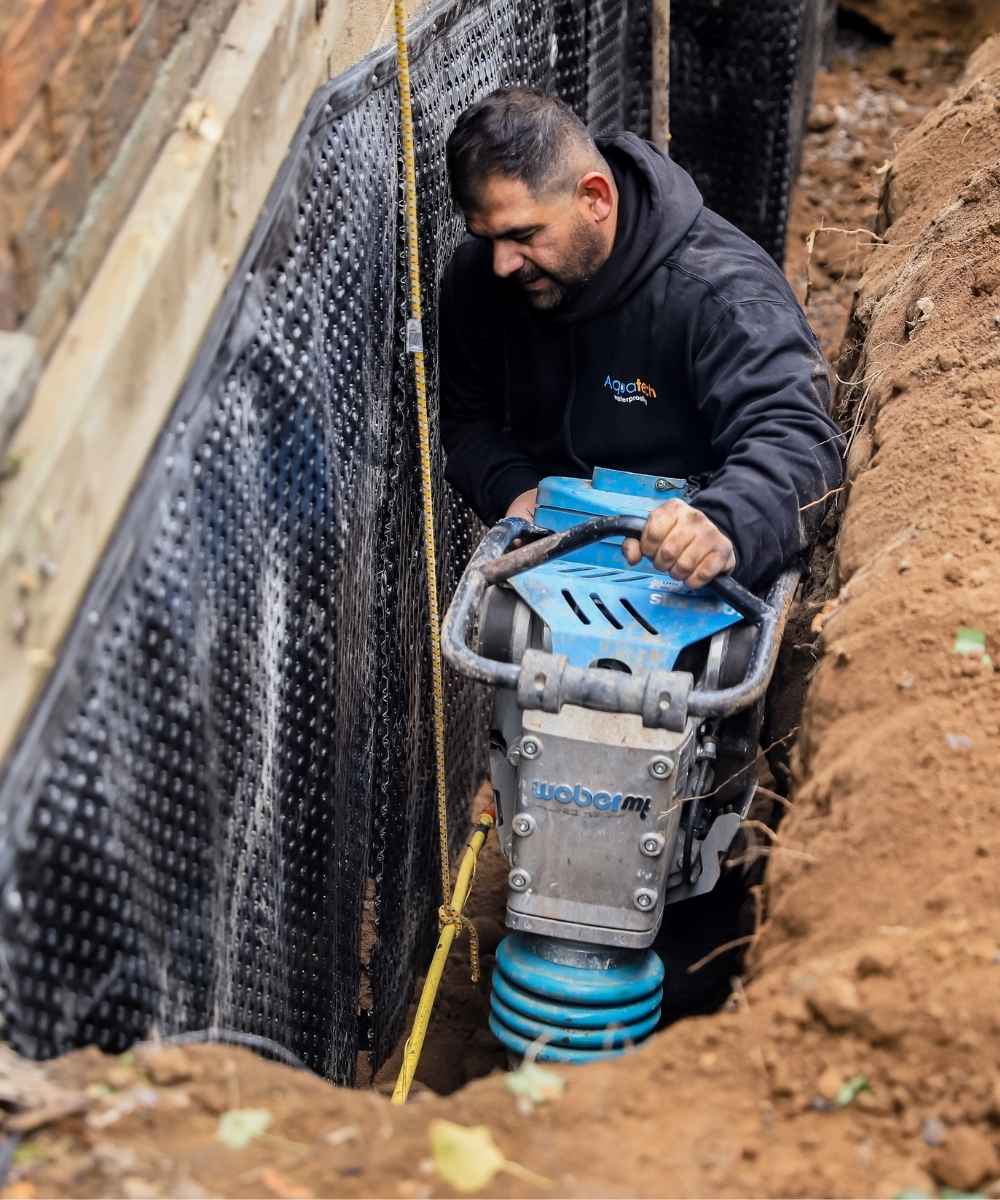
For a below-ground block wall under water pressure, exterior waterproofing is the most lasting answer. The crew digs to the footing, repairs the wall, fixes a membrane to it and installs new weeping tile, so the water never touches the mortar. See how a drainage membrane works.
Interior waterproofing, when you can’t dig
Interior waterproofing manages the water that has already come through. A drain at the floor edge and a sump pit with a pump collect it, and a membrane on the inner face of the wall can direct it down to the drain. It works in any season, and it doesn’t need digging outside.
Crack repair, for a joint that has opened
If a crack has opened along a joint, epoxy injection can seal it from the inside. A crack in a block wall can keep moving, so find the cause first. See how to spot and repair cracks.
What it costs
Exterior waterproofing typically costs $110 to $500 per linear foot, and interior waterproofing $69 to $190. Weeping tile typically costs $60 to $300 per linear foot, a sump pump $550 to $3,650, and crack repair $400 to $800 per crack. Repointing is priced by a mason, so ask for a written quote. Only a free on-site estimate gives you a number for your house. See our cost guide.
How Aquatech helps
We have spent nearly 30 years dealing with leaking block and brick foundations. We start with a free on-site inspection, find where the water enters and why, and tell you honestly whether the wall needs a mason, waterproofing or both. Then you get a written, itemized estimate. A lifetime warranty backs every project and transfers to the next owner. Also, if you have a comparable written quote from a licensed Ontario contractor, we will match it. We usually schedule jobs about 4 to 6 weeks after you accept the quote.
FAQs about mortar joint leaks
What causes mortar joints to leak?
What causes mortar joints to leak?
Is repointing enough to stop a leak?
Is repointing enough to stop a leak?
Why does the water show up far from the leaking joint?
Why does the water show up far from the leaking joint?
Can I fix a leaking mortar joint myself?
Can I fix a leaking mortar joint myself?
Should I use waterproofing paint on the wall?
Should I use waterproofing paint on the wall?
Do stair-step cracks mean a serious problem?
Do stair-step cracks mean a serious problem?
How much does it cost to fix leaking mortar joints?
How much does it cost to fix leaking mortar joints?
Water coming through a block or brick wall?
Book a free assessment. We will find where the water enters, tell you what the wall needs, and give you a written, itemized estimate. You can also call 647-794-1701 or 866-620-8492.
